
| Status: | Active, open to new members |
| Leader: |
John Durrant
|
| When: | Monthly on Tuesday mornings |
Our planning meetings usually take place on the second Tuesday of the month at 10.00am at The Beaumont Centre, Victoria Close, Cheshunt, EN8 9EP.
PREVIOUS VISITS
Images Copyright © 2026 Cheshunt u3a
MARCH 2026
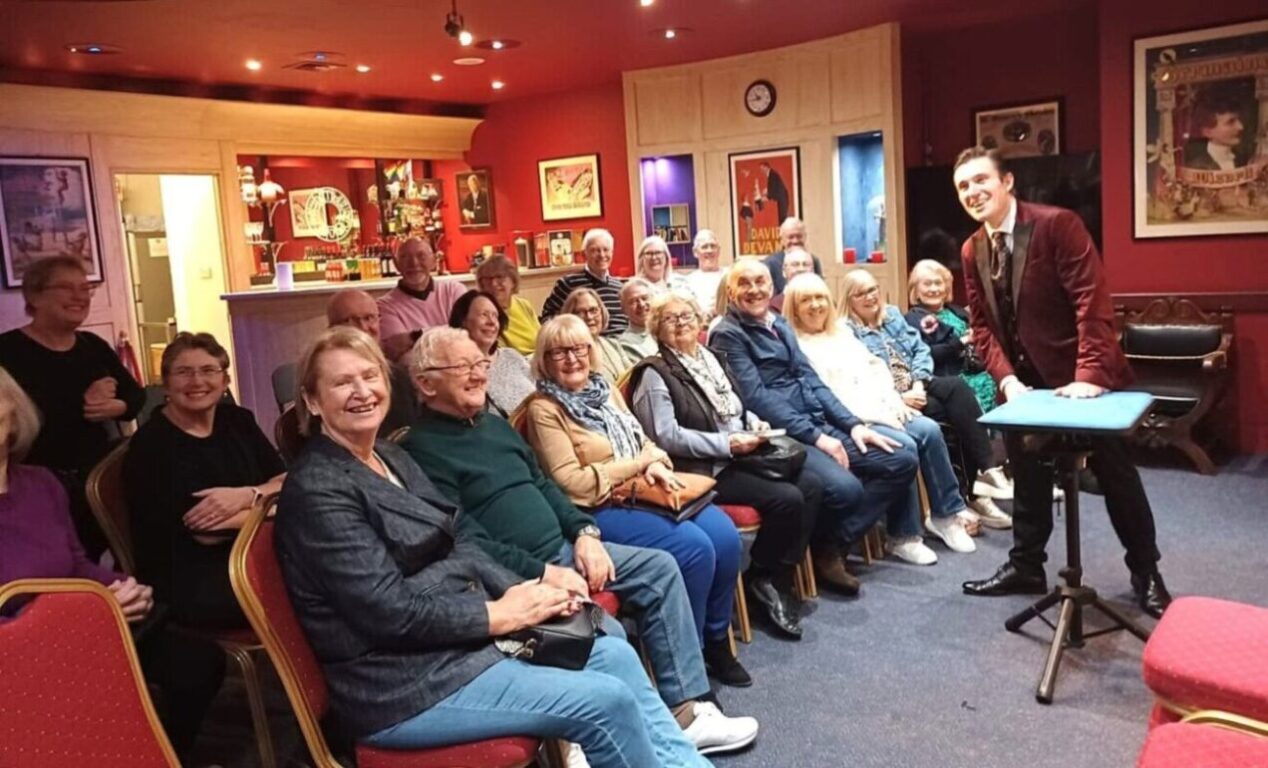
The Magic Circle is situated in a quiet street near Euston Station. The society was formed in 1905 when 23 amateur and professional magicians got together at Pinoli's Restaurant in Soho. Since then The Magic Circle has been at the forefront of the magic community in the UK and worldwide.
Magic was a massive part of theatrical entertainment back then and one of the original magicians also invented the first pay lavatory which required the insertion of a penny to open the door - hence the expression "to spend a penny".
There are currently over 1700 members worldwide and potential new members require a proposer and seconder, must pass an interview and examination - usually a live performance in front of three judges and an audience of members.
In the 1980’s a campaign gathered pace to admit women and this was finally successful in 1991. Now there are now a total of over 80 members.
The wish for a permanent home was eventually successful, and with hard work and with the generosity of members, together with cash from the National Lottery the building was refurbished and opened in 1998.
It is a fascinating building : inside the entrance is a spectacular "helical staircase" with wall murals depicting key scenes from the history of magic.
After tea/coffee and biscuits we enjoyed a thoroughly interesting tour of the building including the theatre and museum which included much magic memorabilia.
Finally we were treated to several very entertaining magic tricks before heading off for refreshments and the journey home.
SEPTEMBER 2025
Wednesday 17th September - Jordan’s Mill, Biggleswade.
JULY 2025
Thursday 10th July - Fullers Brewery.
The Griffin Brewery in Chiswick was established in the late 1600s when The George pub and brewhouse were purchased for £70. It was under the stewardship of the Thompson brothers that the brewery first acquired the Griffin name and emblem in 1816.
John Fuller invested in the struggling brewery in the 1820s, later joined by John Smith and John Turner in 1845, forming the partnership Fuller, Smith & Turner, which remains today.
We toured the brewery wearing hi-viz jackets and were supervised by two guides. We initially admired the 200 year old Wisteria covering one wall of the brewery.
After fermentation, the ale is conditioned (matured) to develop its flavour. We observed all the stages of brewing, and visited the centre from which cans, bottles, casks and kegs are loaded onto the red livery vans and lorries for distribution.
The highlight of the tour was our visit to the hop cellar where beer tasting and a museum display occupied us for a full half hour. And it was deliciously cool!
After purchases of Fullers merch and beer we returned to Cheshunt via a hot and crowded tube system.
Tuesday 29th July - Whitewebbs Transport Museum.
JUNE 2025
After passing through airline style security, our tour of Wimbledon began and ended at the Entrance to Centre Court. Victoria, our Guide, was knowledgeable, fun and patient, although the tight security meant we were also monitored by an assistant tour guide who rounded up strays!
The Championships, Wimbledon, to give the tournament its official title, is the oldest tennis tournament in the world, dating back to 1877. It remains the only Grand Slam event to take place on grass. Women were admitted from 1884, but gained equal prize money as recently as 2007. Televised since 1937, it has evolved from a garden party atmosphere to a globally recognised and highly professional sporting event.
This year there will be no familiar calls of ‘Out!’, as the line judges have been replaced by Hawk-Eye, a system of 18 cameras positioned around the Court, which track the ball’s trajectory. The solitary Umpire’s chair did look rather lonely on the otherwise empty court.
We visited the famous Centre Court, seating 15,000 and No.1 Court, seating 12,345. To ensure the hallowed turf remained untouched by human foot, we sat briefly in the stands of both show courts. Both are now covered, allowing play to continue during wet weather. As closing the roof can take around 10 minutes, all courts have teams of ground staff waiting to pull over the covers in approx 22 seconds!
We visited Court No.18, where in 2010 the longest match at Wimbledon took place between 22nd and 24th June. Lasting over 11 hours, between Isner of USA and Mahut of France, the final score was 70-68. Thank goodness for tie breakers!
The 250 ball boys and girls begin their training in February and are around 15 years old. Girls joined the squad in 1977, with mixed teams of boys and girls from 1980. However, ball girls were not allowed onto Centre court until 1985…
The strict whites only dress code has been relaxed to permit coloured trim and logos up to 1cm in width, and ladies are now permitted to wear dark undershorts, provided they do not extend below their skirt or shorts.
During our tour, we noticed many small electrical maintenance buggies transporting flowering plants around the grounds in preparation for the ‘Champs’, as they are affectionately known. Each plant carries a unique bar code, describing not just which display, but also the position in the display it is destined for. Victoria explained that this ensured the planned effect would always be achieved.
The court grass is mown by preprogrammed robotic lawnmowers every morning, with a cut height of exactly 10mm, with 8mm on match days. And of course, irrigation it controlled by computer…
After touring the museum, we progressed to a local hostelry for refreshments before the return journey to Cheshunt.
MAY 2025
We departed Cheshunt on Thursday 8th May heading for Excel London to experience Tutankhamun: The Immersive Exhibition (a cutting-edge, technology-driven historical experience)
‘King Tut’ (born 1341 BC) became pharaoh of ancient Egypt at the age of 8 or 9. He unexpectedly died aged about 18 and is known primarily for the discovery of his intact tomb in the Valley of the Kings in 1922 by a team led by the British Egyptologist Howard Carter and sponsored by the British aristocrat George Herbert. The tomb contained the king’s mummified body and over 5000 artefacts.
The group enjoyed an extraordinary journey through ancient Egyptian history throughout 6 galleries which included original and replica artefacts, multimedia displays, a virtual reality experience and an AI photobooth where guests can transform into ancient Egyptian citizens (very funny). After an extremely interesting visit we called in at a hostelry in Canary Wharf before continuing the journey home.
APRIL 2025
Despite a very wet start to the day, the sky cleared as we approached the awe-inspiring Swaminarayan Mandir.
As Europe’s first traditional Hindu Temple, its design followed traditional methods. It is composed entirely of Bulgarian limestone and Italian Carrara marble blocks, which were shipped to India to be hand carved by over 1,500 artisans, before being shipped back to London. The 26,300 pieces were then fitted together within 3 years by over 3,000 volunteers.
The result is a magnificent temple with delicate carvings on a massive scale. From the imposing entrance gate to the intricately carved Burmese teak and English oak which form columns, struts, arches, doors, windows and balconies, the exterior approach is spectacular. Inside, there are two majestic courtyards with more teak columns and oak panels. The brightly coloured woolen carpets, the marble staircases, the delicately carved columns and the fluted central dome along with the smaller domes topped with carved spires and flag masts bearing fluttering red and white flags all indicate that the Sovereign Deity is at home. The Mandir is the house of God.
We observed the late morning arti ceremony of light, where lighted wicks are waved before sacred images to the accompaniment of a musical prayer. After learning more about Hindu beliefs and visiting the enormous Assembly Hall, we fortified ourselves with a very tasty and filling buffet lunch in the Shayona restaurant.
Hinduism is a family of many diverse religious traditions, each with its own beliefs, practices and sacred writings. The exhibition, which we visited after lunch, explored those upheld by the Swaminarayan Sampradaya, as well as those common to the wider Hindu community. As the world’s oldest religion, with origins in the Indus Valley 6,500 BCE, it has now spread widely across the globe.
After a very interesting and enlightening visit we returned to Cheshunt just before the rain returned.
MARCH 2025
The Central Criminal Court of England and Wales, is commonly referred to as the Old Bailey, after an adjacent street.
The court has been on the site since the sixteenth century, when it was attached to the medieval Newgate Prison. The current main listed building was completed in 1902. An extension was constructed in 1972 over the former site of Newgate Prison.
The Crown Court sitting in the Old Bailey hears major criminal cases from within Greater London and in exceptional cases from other parts of England and Wales.
On the dome above the court stands the court's symbolic gilt bronze statue of Lady Justice made 1905. She holds a sword in her right hand and the scales of justice in her left. During the Blitz of the Second World War, the Old Bailey was bombed and severely damaged, but reconstruction work restored most of it in the early 1950s, including the interior of the Great Hall which is decorated with paintings commemorating the Blitz. In 1973, the Provisional IRA exploded a car bomb in the street outside, killing one and injuring 200 people. A shard of glass is preserved as a reminder, embedded in the wall at the top of the main stairs.
A plaque is displayed which commemorates the trial of William Penn and William Mead, Quakers, who were tried for preaching to an unlawful assembly in nearby Gracechurch Street. When the jury returned a Not Guilty verdict with which the Judge disagreed, the jury were locked up for two nights without food, water and heating, and a fine was imposed. The jury members applied to the Chief Justice who ruled that a jury cannot be punished for returning a verdict that the Court disagreed with. This ruling still applies today.
After a mock trial in Court Number 1, in which the six defendants were all found guilty, we toured the cells below the courtrooms. After a fascinating tour, we retired to a nearby hostelry before the return journey to Cheshunt.
National Portrait Gallery, 11th February 2025.
On a grey and chilly morning, we travelled to St Martin’s Place to meet our lovely Guide Paula. We were introduced to a wide variety or famous and not so famous individuals, as well as the development of portraiture across the period.
The Tudor and Stewart monarchs were well represented. Self Portraits by Joshua Reynolds and Lucien Freud were striking, and the portrait by Joshua Reynolds of the first Polynesian to visit Britain, known as Mai or Omai, caused much controversy at the time.
Mary Beale is the earliest professional female artist in the National Portrait Gallery’s collection.
The House of Commons 1833, by Sir George Hayter, commemorates the passing of the Reform Act, which extended the vote to a larger group of property-owning men. Unfortunately, it also took away the right to vote for a small number of property-owning women. The Act also provided representation for the large industrial towns, which up until then had had no MP. The painting also shows the layout of the Commons just prior to the great fire of 1834. The picture includes nearly four hundred identifiable figures, mainly MPs, took 10 years to paint, and 15 years to sell, ironically to the National Portrait Gallery!
The following rhyme is well known: “Lucy Locket lost her pocket, Kitty Fisher found it; Not a penny was there in it, Only ribbon round it.” Historically, the term "pocket" referred to a pouch worn around a woman’s waist held by ribbon in the 17th to 19th centuries. Lucy and Kitty were two celebrated courtesans who were rivals.
Stunning oil paintings of Judi Dench, Maggie Smith and Darcy Bussell were admired in the modern section.
Londoner Marc Quinn’s use of non-traditional materials, from blood to silicone to human excrement, speaks of his interest in the beauty and messy reality of the body. Quinn came to prominence in 1991 with his self-portrait Self; his head cast with eight pints of his own frozen blood.
After much needed refreshment, we returned to Cheshunt enlightened, enthused, and for many, slightly repulsed!
Images Copyright © 2024 Cheshunt u3a
Saturday 14th December - Old Royal Naval College
On a grey and chilly December day we traveled to Greenwich for a guided tour of the Old Royal Naval College.
A Tudor Palace was built by Humphrey, Duke of Gloucester which was completed in 1439 and surrounded by a large deer park. Henry VIII was born at Greenwich Palace in 1491. He is known as ‘the father of the Royal Navy’ as he invested heavily in the fleet. He retired frequently to Greenwich Palace as it provided tranquil surroundings close to the docks at Woolwich and Deptford.
Elizabeth I was fond of Greenwich and it became her principal summer residence. From her window she watched the parade of ships returning from the defeat of the Spanish Armada.
Mary I is remembered for her staunch devotion to Roman Catholicism. She spent much of her early childhood at Greenwich Palace.
The Palace fell into disrepair in the Civil War, during which it was used as a biscuit factory and then a prisoner of war camp, before being demolished. Charles I drew up plans for a new palace, but as finances and enthusiasm waned, only one new wing was built.
In 1694 King William III granted a warrant for the site to become a charitable institution for naval veterans, in accordance with his late wife Mary’s wishes. Sir Christopher Wren was appointed to build the Royal Hospital for Seamen. He spent 23 years working on the plans free of charge! Taking over 50 years to complete, the buildings are grand enough to be a Palace, and were designed to house naval veterans, rather like Chelsea hospital did for old soldiers. Greenwich Pensioners numbered 2,700 at their peak, many of them disabled.
They followed a strict timetable, which included attending chapel every day. Playing cricket on Blackheath was a popular pastime, whilst the skittle alley provided wet weather entertainment.
The Painted Hall boasts one of the most spectacular Baroque interiors in Europe. Taking 19 years to complete and covering 40,000 sq ft, it was designed and painted by British artist James Thornhill, for which he earned a knighthood and nearly £7,000.
Nelson laid in state here and following the Hospitals change to the Royal Naval College in 1869, the hall served as a dining space for trainee officers of the Royal Navy.
The Royal Hospital Chapel, designed by Wren, was built by Thomas Ripley. Gutted by fire in 1779, it was rebuilt with nautical motifs to make the Naval pensioners feel at home. In 1962 the site was equipped with its own miniature nuclear reactor, known as JASON, to train officers in operations on board nuclear submarines. Following decommissioning of the site, 270 tons of nuclear waste were removed from the site in 1999. It had been the only nuclear reactor installed in a Grade I listed 17th C building!
Following a visit to “Spoons” for refreshment, we toured the many stalls in the large Christmas Market before returning to Cheshunt.
Friday 22nd November - Musical Museum
On a very chilly November morning we set off for Brentford, where the Musical museum is located, near to Kew Bridge. We were warmly greeted with coffee by the museum director, which was very welcome.
The purpose-built premises, opened in 2008, allowed the transfer of the collection from a nearby draughty, damp and cramped deconsecrated church. Founded 60 years ago with some half dozen player pianos, the collection has grown to include a wide range of musical instruments and unique inventions which tell the story of how music was recorded and reproduced through the ages.
Fortified by coffee, we then enjoyed a short recital on the fabulous 90 year old Mighty Wurlitzer Theatre organ.

Then our amazing guided tour of the museum began. Beginning with a tiny musical box, made in Switzerland in 1789, each instrument was demonstrated and the playing mechanism explained. We soon grasped the importance of the comb, with teeth of varying thickness and length, which produced the notes when struck by pins attached to a rotating cylinder. This became a common theme as we had demonstrated larger and dual combed musical boxes, Pianolas, player pianos, a piano with two violins, and a 1928 ‘His Masters Voice’ gramophone with Bakelite discs, but no Nipper! Of great interest was the very crackly early recording of Frank Sinatra singing ‘Chicago’ on bakelite, played on the HMV gramophone. A sock was placed in the horn to greatly reduce the volume, hence the expression ‘to put a sock in it’.
A 1922 Steinway Reproducing Grand Piano had been manufactured in Germany, but had an Aeolian player mechanism added in London.
Finally, the heavyweights of the museum display downstairs were the Orchestrions. Built in 1899 in Germany and controlled by a piano roll, the sound was produced by pipes, percussion instruments and a piano. The full effect is similar to that of a full orchestra or band. Amazing!
We retired upstairs to the concert hall to enjoy a ploughman’s lunch and cuppa, with a second, but sadly only too brief snatch of the Wurlitzer being played again, before a very worthwhile visit to the gift shop and the return to Cheshunt. A fabulous tour of such an interesting museum.
Monday 14th October - Mercers’ Hall
Livery companies were originally trade or craft guilds, which represented the interests of their members within the City of London. Mercers were merchants who exported English woollens and imported luxury fabrics such as silks, velvets and fine linens.
The Mercers’ Company is ranked number one in order of ceremonial precedence. It was formally incorporated in 1394. The first Hall, completed in 1524, was built next to a monastery on Cheapside, which had been built on the site of the birthplace of Thomas Becket. This first Hall was burned to the ground in the Great Fire of London.
The second Hall was destroyed by enemy action in 1941. The present third Hall opened in 1958.

William Caxton was a Mercer in the late 15th century, and made the first printed copy of Chaucer’s Canterbury Tales. Robert Baden Powell, founder of the Scout and Guide movements, was Master Mercer in 1913. Dick Whittington of pantomime fame was a merchant, politician, a Mercer and four times Lord Mayor of London. He supplied Richard II with fine fabrics, and also lent him money. In his lifetime he financed many good causes. He also formed the Charity of Sir Richard Whittington which, nearly 600 years later, continues to assist people in need. After an interesting and engaging tour, we proceeded to a local hostelry before returning to Cheshunt.

Barbican walk 5th September 2024
We started at the Golden Lane Estate purpose built in a Modernist style in the 1950's. After wartime bombing it was rebuilt as social housing for (mainly single) city workers in relatively modest employment. Designed by Chamberlin, Powell and Bon who went on to design the next-door Barbican, this was a radical departure, emphasizing glass, light and communal facilities including a roof garden, swimming pool and tennis courts.

From here we headed to the Barbican, which, like Marmite, you either love or hate. A Brutalist design, there is a great deal of concrete, yet it has lots of glass, gardens, ponds, covered walkways and communal, inward looking public spaces.

As we left the Barbican we walked out past the now closed London Museum on an elevated walkway. These walkways were seen to reduce traffic accidents by separation the street level below from the pedestrians above. From here we saw mainly recent commercial buildings by superstar architects such as Norman Foster and Richard Rogers,
Sections of the Roman Wall stand next to the Barbican. In the 3rd century AD, the Romans built a wall round their city of Londinium to protect it from the attacks of Anglo Saxon sea raiders. The wall incorporated two of the existing walls of an earlier fort and its towers, called ‘Barbican’.
The Ironmongers Guild Hall was destroyed by a WW1 bomb, and was rebuilt in Tudor style, and compared starkly to the Salters Hall, which was bombed by German aircraft in May 1941, and most of the Hall destroyed. The current Grade II listed Hall was completed in 1976 and is finished in knapped, ribbed and fluted concrete.
We completed our tour in the Guildhall Library, where a giant model of central London can be viewed. Built on a 1:2000 scale it stretches from King’s Cross in the north to Peckham in the south and the Royal Docks in the east to White City in the west.
Refreshed and restored from our usual hostelry visit, we returned to Cheshunt after an interesting and enjoyable day.
Monday 5th August 2024 - Houses of Parliament Tour
On a sunny warm August day, we travelled to Parliament via a Wetherspoons in Holborn. Our first visit was to the Jewel Tower, a little-known gem almost opposite the Palace of Westminster. Dating back almost 650 years, it was built by Edward III as a treasure chest. One of only two buildings from the medieval Palace to survive the great fire of 1834, it has also served as a store for parliamentary records, a wardrobe for the King’s ceremonial regalia and a store for official weights and measures.
Our tour of Parliament began in Westminster Hall, which has a famous hammer beam roof. Built in 1097, it has been a courthouse, and was the scene of the state trials of Charles l and Guy Fawkes.
The rebuilding of the Palace of Westminster following the fire began in 1840 and was completed in 1870. It took 16 years longer and cost three times the original budget. It has a floor area of 16 football pitches, 1,100 rooms, 100 staircases, three miles of passageways, four floors and 65 different levels. We toured the two debating chambers, separated by the central lobby, learned about the parliamentary process for passing bills and how to lobby your MP in the central lobby. Yes, that is how the term originated. Restored by a cup of Parliamentary tea we returned to Cheshunt impressed and informed about our parliamentary and democratic processes.
JULY 2024
Our Guided Tour of Capel Manor on Friday 12th July 2024


Capel Manor is a beautiful Georgian house set amongst 30 acres of picturesque gardens. Boasting a rich history that dates back to the 13th century, the estate is home to 40 colourful gardens.
In 1275 there is evidence of a manor house, and in 1468 Sir William Capel became the owner, and the estate was in the family until the 16th century’ when it was surrendered to the crown.
Queen Elizabeth I gave the house to the Thorne family in 1562 and it then passed through several hands. The current manor dates from 1745. The last private owner bred Clydesdale horses. Indeed the stable yard weather vane boasts a golden Clydesdale horse. When he died he left Capel Manor in trust. The estate’s gardens and outbuildings became increasingly neglected before being saved by local horticulturist Frances Perry, who campaigned for Capel Manor to become a horticultural college with gardens for public use. In 1968 the college opened.
Of particular note are the Which? Gardening Trial Gardens, the Walled Garden, and the Cactus House. A wide range of animals were viewed in the mini zoo. After a hearty lunch we made the short return journey to Cheshunt.
JUNE 2024
Transport Museum visit 11th June 2024.
Opened in 1999, the London Transport Museum Depot is designed for public access to a warehouse, a rail depot, a workshop and an educational space. Its vast collection includes many original posters, vehicle signs, models, photographs, engineering drawings and uniforms. Memorable items include the decorative wrought iron entrance to High Street Kensington Underground station created in 1900, the bright yellow horse bus operated in London from 1880-1911 capable of carrying 28 passengers, and the prototype of the internationally recognised London icon, the Routemaster 1, which made its first appearance in the 1935 Earls Court Motor Show. The world’s first motor bus, the B340, built to replace horse drawn and earlier motor buses, was used at the front line in WWI. Some of the 900 buses deployed were converted to lorries.
Unpainted aluminium alloy underground carriages, lighter in weight and saving decorating costs, were used on the District Line until 1983 and boasted the first fluorescent lighting on the move.
Finally, Harry Beck’s original tube map of 1931 was the first topological map to illustrate the Underground network. It made the system easier to understand by colouring each train route and by using straight lines and 45-degree angles.
Packed with 320,000 items, with volunteers busy at work restoring carriages and obliterating graffiti, we admired many of the displayed items, often exclaiming ‘I remember this!’ which reflects our age, I guess!
After the compulsory gift shop visit, where we were each presented with an historic geographic map of the underground from 1926, we visited a local hostelry before embarking on our journey, by tube and overground, back to Cheshunt.
FEBRUARY 2024
On a bright but chilly Monday a large group ventured to Covent Garden for a backstage tour. Over the course of its 360-year existence, the Theatre Royal, Drury Lane has been demolished, burned down twice, struck by a bomb during the Blitz and forcibly shuttered by the Covid-19 pandemic – rising from the ashes each time to produce yet more renowned productions.
Every reigning British monarch since the Restoration has visited and it’s here that “God Save The King” was first performed in 1745. The song was met with rapturous applause – ultimately proving so popular that it was officially named the national anthem.
The Theatre Royal Drury Lane underwent a £66 million renovation project, having closed its doors in 2019. The unique architecture of this Grade 1 Regency building has been restored to its former 1812 glory. Open to the public all day, the newly restored Theatre Royal Drury Lane, affectionately known as “The Lane”, is re-imagined as a destination for entertainment, food, bars, art and culture, so the iconic interiors can be enjoyed by everyone not just theatregoers in the heart of London’s Covent Garden.
Saturday 9th December 2023 - Canterbury
Tuesday 28th November 2023 - Vintners Hall
SEPTEMBER 2023
On a very sunny and warm late September day, 24 members met our Blue Badge Guide at Temple Tube Station.
She explained that during the 12th and early 13th centuries, law was taught in the City of London, primarily by the clergy. But a papal bull in 1218 prohibited the clergy from practising in the secular courts (where the English common law system operated, as opposed to the Roman civil law functioning in the Church's ecclesiastical courts). As a result, law began to be practised and taught by laymen instead of by clerics.
To protect their schools from competition, first Henry II (r. 1154–1189) and later Henry III (r. 1216–1272) issued proclamations prohibiting the teaching of the civil law within the City of London.
The common-law lawyers worked in guilds of law, modelled on trade guilds, which in time became the Inns of Court.
In the earliest centuries of their existence, beginning with the 14th century, the Inns were any of a sizeable number of buildings or precincts where lawyers traditionally lodged, trained and carried on their profession. Over the centuries, the four Inns of Court became where barristers were trained, while the more numerous Inns of Chancery – which were initially affiliated to the Inns of Court– became associated with the training of solicitors in the Elizabethan era.
The four Inns of Court are Lincoln’s Inn, Inner Temple, Middle Temple and Gray’s Inn. Lawyers have lived and worked in the Temple since 1320. In the 16th century and earlier, students or apprentices learned their craft primarily by attending court sessions and by sharing both accommodation and education. Prior to the outbreak of the English Civil War in 1642, this training lasted at least seven years; subsequently, the Inns focused their residency requirements on dining together in the company of experienced barristers, to enable learning through contact and networking with experts.
In the mid-18th century the common law was first recognised as a subject for study in the universities, and by 1872 bar examinations became compulsory for entry into the profession of law.
The Royal Courts of Justice, commonly called the Law Courts, is a court building in Westminster which houses the High Court and Court of Appeal of England and Wales. Designed by George Edmund Street, who died before it was completed, it is a large grey stone edifice in the Victorian Gothic Revival style built in the 1870s and opened by Queen Victoria in 1882. The building is reminiscent of a Cathedral in both style and scale. It is one of the largest courts in Europe, housing over 100 courts.
Soon after building work began the masons went on strike. Foreign workers, mainly Germans, were brought in. In order to avoid confrontation with the strikers, the Germans lived and were fed inside the building. Carvings on the internal stone pillars record their incarceration night and day.
After a fascinating tour of Legal London we retired to a local Wetherspoons before our return to Cheshunt.
AUGUST 2023
We travelled by train from Cheshunt, changing at Cambridge, and arrived at Ely in plenty of time to enjoy a coffee before our Walking Tour of the City at 11:30am. The sun shone as we learnt that until 200 years ago Ely was an Island, famous for being the source of the best eels in England.
The Cathedral has its origins in AD672 when St Etheldreda built an abbey church. The present building dates back to 1083, and was granted cathedral status in 1109. Having been built in a monumental Romanesque style, parts were rebuilt in an exuberant Decorated Gothic. The central octagonal tower, with lantern above and the east Tower dominate the surrounding landscape.
Stone for the Cathedral was quarried in Northamptonshire and arrived by boat, having been purchased for 8,000 eels. The Benedictine monastery was dissolved by Henry VIII.
Oliver Cromwell’s House was visited by many of our group, whilst others toured the Cathedral and tower, the Museum or explored the waterfront. Oliver Cromwell was born into a wealthy Huntingdon family, although his branch was junior, and he had to leave his Cambridge College to look after his estate, his widowed mother, his wife and ultimately his 9 children. He inherited several properties in Ely, including the lease on a house to which his family moved.
The lease required him to collect the local taxes. Cromwell, a devout Protestant, disapproved of changes to the church proposed by Charles I. When war broke out between King and Parliament, Cromwell was one of the first MP’s to take up arms and fight. When a new Model Army was raised, Cromwell rose from being a country Gentleman to MP and finally to military leader. Following the beheading of Charles l he became Lord Protector. He died from a fever in the Palace of Whitehall and was given a royal funeral. Two years later Charles ll was restored to the throne and Oliver’s body was exhumed, hanged and beheaded.
JULY 2023
On Tuesday 25th July we set out on a grey but dry day for two great visits. Relieved that the threatened tube strike had been lifted, we arrived at the National Army Museum for coffee and a visit to the recently refreshed exhibition galleries. These cover the role of the Army from the British Civil War to the modern day. Thoughts and ideas are explored, as well as real stories of real people. The way we think about the Army was also challenged, as well as our relationship with it. A thought provoking place to visit.
Refreshed by lunch, we walked a few minutes down Royal Hospital Road to the Chelsea Physic Garden. Celebrating its 350th anniversary this year and originally set up by the Worshipful Society of Apothecaries, its original purpose was to provide medicinal plants. It is the only Botanic garden collection focused entirely on medicine, herbal and useful plants.
Originally it was an outdoor classroom for training apprentice Apothecaries, who are known as pharmacists today. They were trained to identify different plants and to understand their uses. Today over 4,500 species are crammed into the 4 acre site, helping tell the story of humanity’s relationship with plants. Our two Tour Guides were knowledgeable and friendly. Indeed Paula, who has guided us on several Blue Badge Tours, is a volunteer guide at the Garden, and picked out our visit especially. Thank you Paula.
Refreshed by more tea and in some cases cake, we returned to Cheshunt educated, informed and entertained by our day in London. Sir John Reith would be proud! I note that Mick Jagger held his 80th Birthday Bash at the Physic Garden last night, so perhaps we should add Cool to the list of its Attributes!
JUNE 2023
On a sunny early June morning we met at Cheshunt station for the easy rail journey to Kings Cross, with a short walk to the Canal Museum in Gatti’s Ice House. A brief introductory talk outlined the history of the museum, its original use as an ice store, and the role of the wharf in Battlebridge basin just off the Regents Canal.
The canals made the industrial revolution possible, providing transport for raw materials and fuel such as coal, and transporting finished goods made in the new factories. Today many have survived, and we enjoyed a short canal trip through the Islington tunnel and back, admiring the restored industrial architecture which today form up market housing backing the canal.
The two commercial icewells in the floor of the museum reflect the building’s role in storing imported Norwegian ice for use by London hotels, fishmongers, dairies, hospitals and the well to do who could afford to keep their milk cool. Built in 1850s and 1860s for Carlo Gatti, the ice arrived from the docks by horse drawn barge. Indeed horses were stabled in the upper floor of the museum, as the ice was delivered by horse drawn carts. Horses provided the power for all Canal barges at the time, and stabling was found along all London towpaths.
The talk covered how locks work, allowing barges to climb and descend hills, whilst conserving water.
Industrialisation on the river Lea formed an interesting section of the museum display, outlining the importance of the canalising to form the Lea navigation.
The history of the Gunpowder Mills and the explosion of a barge carrying Gunpowder on the canal in Regents Park in 1874 were colourfully explained.
The highlight of the morning was the leisurely trip aboard the narrow boat Long Tom, where coffee and biscuits were served and a brief account of the industries which used to line the canal.
We moved on in traditional style to a local Wetherspoons, after which some explored different local attractions, including Coal Drop yard, Granary Square and the Crick Institute.
JUNE 2023
Exploring London 5 visit to Kensington Palace.
Kensington Palace was once a small suburban villa, known as Nottingham House. New monarchs William III and Mary II chose this modest mansion in 1689 to be their country retreat. Over the years, Stuart and Georgian monarchs transformed the palace into a fashionable home for Britain’s young royal families. Queen Caroline shaped the palace and gardens, and Queen Victoria spent her childhood here.
Who would have thought that parallels could be drawn between dressing for the Royal Georgian Court in the 18th Century and dressing for red carpet events today? Well, we learnt that there are many similarities: making political and social comments, dressing to be noticed in outrageous costumes, dressing to impress and not least dressing up for an occasion.
For court wear in the early 18th century, women wore the open-fronted mantua, with a train and matching petticoat. To give the figure the required shape, stays (an 18th century precursor to the corset) and hooped petticoat, or panniers, were worn underneath. Designed to reflect the wearer’s status, mantuas were typically decorated with opulent embroidery incorporating gold or silver thread or gilt lace. The skirts were up to 3 metres wide and walking and dancing in them took much practice. Georgian men, by contrast, wore relatively traditional outfits. A Georgian man’s suit consisted of the same three basic pieces as today: waistcoat, jacket, and breeches. Rarely were the three pieces not matching in colour and style. Vivid, bold colours were normal, but whether colourful or a subdued brown or cream, jackets and waistcoats were highly embellished and fancy. Breeches with white stockings were the standard leg covering, which matched the jacket and waistcoat. Suits were made to be a single ensemble, and not to mix and match. Men’s shoes had heels, low heels, but heels just the same. Big buckles and other decor were common, and the shoes were often as brightly coloured as the suit.
Set amongst the Georgian finery were contemporary red carpet outfits. The custom Moschino chandelier-inspired outfit designed for Katy Perry and worn at the 2019 Met Gala consisted of a small chandelier perched on her head and a larger chandelier surrounding her body. Sitting down became out of the question! Other key iconic looks from recent years include Billy Porter’s "Sun God” for the 2019 Met Gala, and Kendall Jenner’s shimmering Hepburn-inspired Givenchy dress worn to the 2021 event. Outrageous, eye opening and often jaw dropping the exhibition included men in dresses and women in suits. Make of it what you will.
In addition there is an exhibition upstairs, called “Victoria: A Royal Childhood” which displays the rooms in Kensington Palace as they were when Victoria grew up there.
The Jewel Room displays an incredible suite of jewellery, including specially commissioned gems for Queen Victoria and magnificent examples of red carpet accessories as part of the Crown to Couture exhibition. The Jewel Room also displays commissioned gems for Queen Victoria by her beloved husband Albert.
Sadly, rain and limited time prevented an exploration of the gardens, so we retired to a Wetherspoons for refreshment before battling with a reduced train service, due to a rail strike, for a return to Cheshunt.
APRIL 2023
Exploring London 5 visit to The Museum of the Home, April 2023.
The Museum of the Home has is situated in 300 year old almshouses in Hoxton. The almshouses were built in 1714 and funded by Sir Robert Geffrye. They provided homes for the poor pensioners of the Ironmongers company. Twice master of this Company and a previous Mayor of London, Robert Geffrye left money to set up Almshouses in Hoxton for 50 pensioners in 1714. He is immortalised in the centre of the Almshouse, still there today, despite public pressure to remove the statue because of his links to the transatlantic slave trade.
By the dawn of the 20th Century Hoxton was overcrowded and largely full of unsavoury slum dwellings. The Ironmonger’s Company sold their Kingsland Road property to relocate to a nicer, airy part of London and the almshouses were bought by the London County Council in 1911. The LCC saw that they could give new purpose to the almshouses by turning it into a museum.
In April 1914 the Geffrye Museum opened to the public as a museum of woodwork. In the mid-1930s a chronological run of living room displays was created, for learning about the history of domestic life and everyday things. Over the years the Museum evolved, presenting paintings, furniture and decorated arts in the context of living rooms.
An extra wing was added in 1998 and period gardens were developed. The gardens echo changes in society and the wider world and show the fashions and innovations of the time. One of the 14 almshouses was restored to show the living conditions of former residents in the 1780s and 1880s. It was renamed The Geffrye Museum of the Home in 2011.
The Museum closed in 2018 for an extensive rebuilding, and reopened with new galleries and learning spaces. We thoroughly enjoyed our visit to Hoxton and, in our time honoured way, moved on to a Wetherspoons in Old Street.
MARCH 2023
On Thursday, 9th March we enjoyed a guided tour of the highlights of the Victoria and Albert Museum. Under the expert attention of our guide Paula, we were steered through the magnificent Parlour from the Old Palace in Bromley by Bow. Dating from 1606, the beautifully carved wooden panelling, the stone chimney-piece, featuring a frieze of carved birds and monsters, which were probably originally picked out in gold and colours, and the elaborate plasterwork ceiling are all magnificently preserved.
The magnificent plaster cast of Trajan's Column is one of the stars of the V&A collection, and has towered over the cast collection in two halves since the opening of the Courts in 1873. A monumental feat of moulding, electrotyping, casting and engineering, the column perfectly demonstrates the complexity and skill of copying in the 19th century.
Other highlights included a 1670 manicure set, featuring a tiny spoon for removing earwax, a tongue scraper and a toothpick. The Hereford Cathedral Choir screen, designed by George Gilbert Scott is a premier example of Victorian Gothic metalwork. It was removed and stored in packing cases until restoration began on 1997. It is now displayed in the Ironwork gallery.
The Great Bed of Ware created much interest, being made locally in the 1590’s in the typical style of the period in carved wood. It has ropes rather than springs and reputedly slept 4 couples! Over 10 ft 8 inches wide, it is remarkable for it’s large size. It is thought that an Innkeeper of Ware had it made as a curiosity to attract customers, as Ware is located 22 miles north of London, a day’s journey from the capital on horseback or by coach. Mentioned by Shakespeare in Twelfth Night in 1601, and by Ben Johnson as ‘The Great Bed of Ware’ in a play of 1609, carved initials and red wax seals left by visitors may be seen on the bedposts and headboards today.
FEBRUARY 2023
On 21st February a large group enjoyed an interesting and informative tour of Covent Garden. Home of the Royal Ballet, The Royal Opera and The Orchestra of the Royal Opera House, the current building is the third to occupy the site. The first, the Theatre Royal, Covent Garden, was completed in 1732 and was originally a playhouse. This was destroyed by fire in 1808, and was rebuilt, to be destroyed again by fire. The current building was opened in 1858, and underwent a large extension, which was completed in 1999. This added the adjacent Flower Market, now known as the Floral Hall.
We toured the Costume department, and learnt of the workshop and costume store in Thurrock. No costume is ever thrown away, and some of the oldest in regular use date from the 1960’s. We watched members of The Royal Ballet rehearsing for the evening show, and were shown the magnificent auditorium. Tiers of boxes in a horseshoe shape provide fabulous views of the stage. Finally we browsed the display of historic posters and programmes on display in the foyer of this famous London landmark.
NOVEMBER 2022
On 24th October we enjoyed a splendid guided tour of the Highlights of the British Museum. Our guide Paula began with the Ancient Civilisations of Mesopotamia, situated within the Tigris-Euphrates river system. It was here the wheel was invented, the first cereal crops were grown and their use of cuneiform script is the oldest form of writing.
The Ancient Greek Civilisation gave us democracy, theatre, philosophy and the Olympic Games. We admired the impressive Parthenon (Elgin) Marbles, part of the Acropolis in Athens and taken by Lord Elgin to London. The Greeks would really like them returned!
The Rosetta Stone message is written in three types of script, allowing Egyptian Hieroglyphics to be understood. The impressive statue of Ramesses ll, a public statement of the King’s divine status and power, depicts Ramesses as young, handsome and athletic. No visit to the British Museum is complete without visiting the mummies! As it was half term we hastened through the Mummy Gallery, stopping only to hear a detailed description of the gory process of mummification. This was not for the fainthearted!
Finally, we moved on to some ancient finds made in the UK. The Mildenhall Treasure consists of 34 pieces of Roman Silver tableware of the fourth century. Ploughed up in a farmers field, he took them home, cleaned them with a Brillo pad and kept them on his sideboard. A visitor recognised their worth, they were seized and given to the British Museum.
The Great Ship burial of Sutton Hoo is the richest burial found in Northern Europe. 1,400 years ago a king or great warrior of East Anglia was laid to rest in a 90 foot boat, surrounded by his extraordinary treasures. Silverware from distant Byzantium, Sri Lankan garnets, fine feasting vessels and an iconic helmet with human mask were discovered in this early seventh century burial mound.
We retired, as usual, to a local hostelry completing a very interesting and informative day.
OCTOBER 2022
Copped Hall is a fine Georgian mansion that is currently undergoing extensive restoration. A Tudor Mansion was demolished to make way for a Georgian Mansion, which was extensively damaged by fire in 1917 and abandoned. The Copped Hall Trust saved this mansion and gardens by purchasing them in 1995. An interesting feature was the Winter Garden, a large glass domed structure reached by a glazed corridor, which contained a large circular lily pond and was filled with exotic trees, plants and statuary. It had its own boiler room feeding hot water pipes that ran beneath the floor to maintain warm conditions. Restoration is well under way. King Henry’s Walk was a tall yew tree avenue (the trees being felled in 1950 for their timber) and the oldest man made structure in the gardens, pre-dating the Elizabethan house. King Henry VIII used this walk when staying at the old Tudor Hall. It has been replanted in its original formation.
Our visit to the Walled Garden, probably the biggest in the South East at about 4 acres, was particularly memorable. Gardens such as these produced fruit, flowers and vegetables and contained extensive greenhouses. It was in a completely derelict state when volunteers recreated the layout of the gardens and are once again growing the full range of produce. Sales of garden plants to our members were very brisk! We were treated to a delightful coffee break in the Racquets Court, which included a choice from a huge range of homemade cakes. Excellent! Rooms throughout the mansion are being steadily restored and the principal Portland Stone Staircase has been progressively rebuilt to second floor level. A lightwell stretched from the basement to roof level, the inner walls of which, made from glazed white bricks and tiles, reflect light into the inner facing windows. Major restoration works to the windows and glazed bricks together with a new roof now allows light to enter as before. Much of the man and woman power is provided by stalwart volunteers, including our knowledgeable and friendly tour guides. It was a truly memorable and interesting visit to a local landmark
JULY 2022
In early July we visited Cambridge by train. Unfortunately, a tree had decided to interfere with the overhead power lines in the Sawbridgeworth area, resulting in no trains running from Cheshunt. In the end we went via Finsbury Park arriving in Cambridge two hours late ! We met our very understanding guide, and had a brief introduction to the college in the beautiful Old Library. This was the original College Chapel, dating back to the 14th Century.
Pembroke College, founded in 1347 by Marie de St Pol, Countess of Pembroke, is third oldest of the Cambridge colleges and was the first to have its own Chapel. Pembroke is the earliest Cambridge College to survive today on its original site with an unbroken constitution from its foundation. We admired the wonderful plaster ceiling of the Old Library before joining the students and staff for lunch in Hall.
Refreshed and recharged, we resumed our tour of the college. The current Chapel owes its origins to Matthew Wren, Bishop of Ely. During his imprisonment in the Tower of London during the Civil War he vowed that, if he were released, he would build a new chapel for his College. This he did, choosing for the architect his nephew, and the Chapel of Pembroke, consecrated in 1665, is the first completed work of Sir Christopher Wren and the first chapel in Oxford or Cambridge in the classical style.
Famous Pembroke alumni include Eric Idle, Tim Brooke-Taylor, Clive James and Peter Cook, Thomas Gray(of Elegy fame) and William Pitt the younger.
Pressing on to the Botanic Gardens we enjoyed a Tour again lead by our ever knowledgeable tour guide. The first director of the garden, a certain John Stevens Henslow was invited to join HMS Beagle, but nominated Charles Darwin to take his place. This experience allowed Darwin, following discussions with Henslow, to develop his theory of evolution.
Thankfully the trains were running to schedule for our return journey, so after a hasty cuppa we returned to Cheshunt as planned. It was a day full of history, beautiful gardens and gave us a taste of Cambridge College life in the 21st Century.
JUNE 2022
We met our knowledgeable and friendly guide Paula, who was waiting beside a statue of two child refugees from the Nazi programs in Liverpool Street Station, which was the main place of arrival and the meeting point for children and their eventual foster families. We then admired a second Kindertransport commemorative statue called the Arrival outside the station in Hope Square. Four children stand proud and poised, with their luggage beside them. It was a sober reminder of the recent history of a busy London mainline station.
Who knew that a Victorian Turkish Bathhouse stands surrounded by tall office buildings 5 minutes walk from this station? Built in Victorian times to provide bathing facilities to the local community, and opened in 1895, it had marble floors, sunken baths, mosaics, stained glass and glistening gold fittings. Passing the old Nat West Tower, Austin Friars was the site of an Augustinian Friary in the City of London between 1260 and its dissolution in 1538. Covering 5.5 acres, it became the home of the Dutch Church, and the Dutch language is still used for services held there.
The Merchant Taylors' Company began as an association of working tailors. It received its first royal charter in 1327 and is the only ancient Livery Company to remain on its original site.
The Royal Exchange was Britain's first specialist commercial building and was officially opened on 23 January 1571 by Queen Elizabeth 1, who awarded the building its royal title and a licence to sell alcohol and valuable goods. Only the exchange of goods took place until the 17th century. Stockbrokers were not allowed into the Royal Exchange because of their rude manners, hence they had to operate from other establishments in the vicinity, such as the newly established coffee houses. The golden Gresham Grasshopper is the Royal Exchange's weathervane and was the crest of the founder, Sir Thomas Gresham.
Progressing down Popes Head Alley, we reached Lombard Street which is where modern banking began. Goldsmiths would hang out signs to attract business, forerunners of the modern logo. A few Edwardian replicas of these signs remain.
Following the narrow alley Bengal Court, we entered St Michael’s Alley, where, in 1652 the first coffee house in London was opened. Set within a warren of medieval streets, it was opened by an importer of goods from Turkey that included coffee. Coffee houses opened to allow the wealthy to try this new and exotic drink.
There has been an inn on the site of the George and Vulture since 1142. It was said to be a meeting place of the notorious Hell-Fire Club and is now a revered City chop house.
Finally we visited Leadenhall Market which began life as a forum in the centre of Roman London and there has been a market on the site since the 14th Century. Following St Peter’s Alley, we admired the rear entrance of The Counting House, which only became a pub in 1998. Nonetheless it operated as a bank for many years. A counting house! . Founded in 1759 it was rebuilt in 1893 as Prescott’s Bank and became part of the Nat West network in 1970. Cornhill is London’s highest hill and was probably the site of the Roman Basilica. Cornhill later became dominated by a medieval grain market, hence the name.
MAY 2022
On May 9th we travelled by coach to Windsor for a fun filled day. The sun shone, the Royal Standard flew on the Round Tower, the M25 and M4 cooperated fully, and the group enjoyed the full range of activities on offer. 18 members chose to visit the Castle, where the Dolls House, the State Apartments and St George’s Chapel were toured, guided by Multimedia headphones and screens. Windsor Castle is the oldest and largest occupied castle in the world. Founded by William the Conqueror in the 11th century, it has since been the home of 39 monarchs. Today The Queen spends most of her private weekends at the Castle.
Also on offer and enjoyed by many were open topped bus rides around Windsor, self guided walks around the town, strolls in the Great Park, once a hunting ground for Henry VIII, River boat trips, Riverside walks and a stroll over the river to Eton College. Some of the group took advantage of the exclusive shopping opportunity, and many ended up in Wetherspoons for a refreshing and reviving lunch. After a busy day enjoying as many of the delights of Windsor as we could, we journeyed home vowing to return to take full advantage of the 12 months annual pass that the Castle ticket offers.
APRIL 2022 PART 2
On 30th April We enjoyed a fascinating visit to the Crossness Pumping Stations as part of Victorian London’s sewage system designed by Sir Joseph Bazalgette and opened in 1865. The building, designed by Charles Henry Driver, is a grade 1 listed industrial heritage site and a masterpiece of 19th-century engineering, architecture and design. It features spectacular ornamental cast ironwork which has been described as “a Victorian cathedral of ironwork”. Our guide was extremely knowledgeable and enthusiastic and the visit exceeded all our expectations. We thoroughly recommend it to members as well as to other Exploring London groups.
APRIL 2022
On 11th April a small group visited Strawberry Hill House, Twickenham. Despite unexpected rail disruptions, we travelled by train, underground and bus, downed a quick coffee in the cafe, and began our tour of the Gothic revival mansion.
Strawberry Hill House’s story begins in 1747, when Horace Walpole discovered and purchased a couple of cottages with views of the Thames and set about transforming them into his vision of a ‘little Gothic castle’ with pinnacles, battlements and a round tower. Thus Strawberry Hill House was born.
Gothic vaulting, medieval tombs and rose windows abound, and the house was passed down within the family, with each generation extending and modifying the building. In 1925 it became a teacher training college, and was greatly extended. The original Gothic Castle underwent a £10 million restoration between 2006 and 2011, to produce the fabulous and fascinating monument to Gothic Revivalism that we so enjoyed visiting.
MARCH 2022
On 3rd March 33 members visited the Shakespeare's Globe theatre it is a reconstruction of the Globe Theatre, an Elizabethan playhouse for which William Shakespeare wrote his plays, on the south bank of the River Thames. The original theatre was built in 1599, destroyed by the fire in 1613, rebuilt in 1614, and then demolished by Puritans in 1644. The modern Globe Theatre is based on available evidence of the 1599 and 1614 buildings. Modern safety requirements mean that it accommodates only 1,400 spectators compared to the original theatre's 3,000. What a squash!
Shakespeare's Globe was founded by the actor and director Sam Wanamaker, built about 230 metres from the site of the original theatre and opened to the public in 1997.
JANUARY 2022
On Tuesday January 25th, 30 members of Exploring London 5 toured Mansion House. It was a cold and grey day, with a chilly wind, but our spirits were high as we walked through the city from Liverpool Street Station.
Before the Great Fire of London in 1666 Lord Mayors used their own houses or livery halls for their work. The idea of creating a permanent residence resulted in George Dance being chosen to design and build Mansion House, which was completed in 1758.
Imposingly Palladian in style, the entertaining rooms were built on the first and second floors. The first floor had a roofless courtyard (later covered to form the Salon, the entertainment space) and the great Egyptian Hall. The second floor has a ballroom and private apartments of the Lord Mayor and family. The third and fourth floors contain meeting rooms and staff rooms. The cellars have storage space and once held prisoners' cells, reflecting the former use of the Mansion House as the Lord Mayor's Court.
Huge sparkling chandeliers, ornate plaster ceilings, essential symmetry achieved using false doors, a fabulous fireplace in the gents loo, and the Hall keeper's Chair, designed to keep the draught out as he met and greeted the Lord Mayor's guests outside, which contained a draw at the bottom to put a hot pan or coal in to keep the Hall keeper warm are striking memories. The Egyptian Hall, seating 350 was being prepared for a Livery House banquet that very evening, whilst a fabulous collection of 17th century Dutch and Flemish Art and statuary lined the walls. Finally we explored the vault, stuffed with Gold and Silver plate from ancient to modern. The Keeper and Polisher of the plate kept a very close eye on us as we exited!
JANUARY 2022
On Tuesday 18th January, 19 members visited Forty Hall for a guided Tour. The partly frozen lake was, as ever, busy with water fowl, and the 300 year old Cedars of Lebanon tree looked magnificent on the frost covered ground. We were welcomed into the Great Hall by our tour guide, dressed in 17th Century costume of wool and linen. Set in its own Estate, with walled garden, formal and informal gardens, lakes, lawns, and meadows, Forty Hall is Grade 1 listed and important to architectural English history as a fine example on the cusp between the medieval to modern style.Built by former Lord Mayor of London, Sir Nicholas Rainton, in 1632 the Hall stands on the edge of London and is important to understanding the growth of the Capital City and of the life and times of the merchant classes.The Elsyng Palace scheduled monument lies within the Forty Hall Estate. The palace is a unique and nationally significant archaeological monument, not only as the site of an early Tudor courtier's palace later developed by Henry VIII, but as a complex multi-phased landscape with a rich history stretching back to medieval times. The palace was also a childhood residence of King Edward VI and Queen Elizabeth I. The group then moved on to The Salisbury Arms, where the numbers swelled to 42. We enjoyed a festive lunch complete with Christmas Crackers, mince pies and coffee. Despite the chilly start, a great day was had by all. Future visits planned:
DECEMBER 2021
On Friday 3rd December, a small group visited the fascinating Museum of London. Tracing the development of the UK’s capital city from prehistoric to modern times, the museum is situated in the Barbican, close to the London wall. The city changed and grew during Roman and Saxon times, and in the medieval era was ravaged by civil wars, plague and fire. The modern London galleries display Victorian London streets, recreated pleasure gardens and the magnificent Lord Mayors Coach.
NOVEMBER 2021
On 11th November 26 members enjoyed a tour of Fulham Palace and gardens, the home of the Bishops of London from AD 704. At one time 36 acres of the estate were enclosed by a moat, creating the longest moat in England. Around 1495 the Tudor courtyard and great hall were built and in 1600 Queen Elizabeth visited and enjoyed a lavish banquet in her honour in the Great Hall. The gardens were relandscaped in the 1761's and a walled garden created. A clock was added to the bell tower in 1770: the bell itself is 100 years older and was commissioned from the Whitechapel Bell Foundry. In 1918/9 the Palace was used as an auxiliary military hospital for soldiers wounded in WW1. 1973 was the last year that a Bishop lived at the Palace and in 1975 the Palace was leased for 100 years to the London Borough of Fulham and Hammersmith. The gardens were opened to the public and two phases of restoration were completed in 2006 and 2011 upon which The Fulham Palace trust was formed to look after the site. The group crossed Putney Bridge for refreshments at a hostelry called The Rocket
OCTOBER 2021
"On October 19th, 19 members of Exploring London Group 5 visited The Charterhouse. En route, we called in to view Postman’s Park, named after postmen from the nearby old General Post Office, which contains 54 plaques each dedicated to an ordinary person, who did something most extraordinary: gave their life in an attempt to save someone else. Devised by George Frederick Watts, it opened in 1900, with the most recent plaque being added in 2009. Watts believed that the material prosperity of a nation is not an abiding possession: the deeds of its people are. With this noble thought in mind, we pressed on for lunch at a local hostelry before reaching The Charterhouse.
This ancient building, dating from 1348 has served as a monastery, private mansion, boys school and an alms house, which it remains to this day.
During the Black Death, the land was used as a burial site. This was followed in 1371 by the building of a Carthusian monastery, which flourished until the monasteries were dissolved, when it became a mansion for wealthy nobleman and a refuge for royalty. In 1611 it was bought by Thomas Sutton, who established alms houses for elderly sick and injured pensioners known as Brothers, as well as a school. When the school moved to Godalming in 1872, the Brothers remained, admitting ladies, also known as Brothers, in 2016. The tour included the newly refurbished medieval Great Chamber, where Elizabeth 1 met her privy Council, the Cloisters where schoolboys played football and the offside rule was devised, and the Great Hall, where Brothers gather daily for meals. We were interested to learn that the current Master of Charterhouse, and the first in its 400 year old history, is a woman!
LATE SEPTEMBER 2021
"On Wednesday 29th September eleven members visited the extraordinary Eltham Palace. Eltham is a unique marriage between a medieval and Tudor palace and a 1930s millionaire’s mansion.
Mentioned in the Domesday Book, Eltham was acquired by the Bishop of Durham who, in 1305, rebuilt the Manor House and presented it to the future Edward II. From the 14th to the 16th century it was an important royal palace, where monarchs often stayed and hunted in the extensive parkland. Subsequent monarchs spent time and money restoring the Palace. Henry VIII passed much of his boyhood at Eltham, and was the last monarch to spend substantial amounts of money or time there. Over the next two centuries Eltham Palace was used as a farm and the buildings were tenanted.
After centuries of neglect, Eltham was leased to Stephen and Virginia Courtauld in 1933, who built an up-to-the-minute house that incorporated the great hall. The result was a masterpiece of 20th-century design.
The exterior of the new house, inspired by Hampton Court, is designed to complement the great hall.
The house was ideally suited to display the Courtaulds’ extensive collection of works of art. It also provided ample space for entertaining their broad social circle. As well as royalty, visitors included many celebrities.
The Courtaulds also took full advantage of new technology. There were electric fires, synchronous clocks powered by mains electricity and a loudspeaker system that could broadcast records to rooms on the ground floor. A private internal telephone exchange, a centralised vacuum cleaner, and gas powered underfloor and radiant ceiling heating were installed throughout. Keen horticulturalists, the Courtaulds also created a variety of garden features including a rock garden, formal rose gardens and a series of garden rooms.
Eltham Palace claims to be the finest Art Deco house open for visitors. We. certainly wouldn’t argue with that!"
SEPTEMBER 2021
On Monday 14th September 14 members enjoyed a self guided walk around the Spitalfields area. In Spital Square we met 21 statues representing orphaned infant elephants now in the care of the Sheldrich Trust. The walk continued looking at various points of interest including Christ Church Spitalfields, fire insurance badges, lovely Georgian houses, and large attic windows which let in light for Huguenot silk weavers in the 1700/1800’s. We admired the diversity of local knockers which adorn the front doors of the area. The Truman Brewery in Brick Lane, once employing over 2,000, closed in 1989. It is currently home to over 100 small businesses, but Tower Hamlets Council, against much local protest, has recently approved its development into prime office space and a shopping centre.
We passed through Spitalfields Market en route to a local hostelry, where fine vittles and ales were enjoyed, before the return journey. Some members could not resist the opportunity to return to the market for further bargain hunting.
AUGUST 2021
On Saturday 14th August 15 members visited the Lowewood Museum in Hoddesdon and enjoyed a very interesting visit. Members of staff were extremely welcoming and it provided the group with plenty to remember and reminisce over. Unfortunately the temporary exhibition ‘Tankards, Tales and Taverns’ was unexpectedly closed, but hopefully should be available again soon. It is due to close on 6th November. The thought of the ‘tankards and taverns’ seemed to entice members to the visit The Star for lunch. This grade II listed building dates back to the early 1500s and in 2014 some 500 year old murals were discovered by builders. These are on display inside The Star and were enjoyed by all.
FEBRUARY 2020
On Monday 24th February 25 members enjoyed a very interesting tour of Freemasons Hall. The tour started with a film, showing what it is like to become a freemason with all the dress and pomp, followed by a visit to the museum which included Winston Churchill’s apron and a throne made for the future King George IV. Next we were shown the Memorial Shrine and Roll of Honour and lastly the wonderful Grand Temple with its mighty bronze doors weighing 1¼ tons each, gilt thrones and a superb pipe organ.
It is generally considered that the freemason movement was formed by stonemasons who had the freedom to travel. In 1717 four London Lodges declared themselves a Grand Lodge in the Goose and Gridiron Tavern in St. Paul’s Churchyard. The Book of Constitutions of Masonry first published by 1723 and in its updated form regulates all Lodges and freemasons in the UK. The organisation is one of the largest charitable givers in the country.
JANUARY 2020
Hertford Castle, the Plague, Parliament Square and McMullens.
On Tuesday 21st January 28 members enjoyed an extremely interesting tour of Hertford Town. Settled by the Anglo-Saxons at the confluence of 4 rivers, namely the Beane, Rib, Mimram and Lea, Hertford grew to include a Norman motte-and bailey-castle. The main surviving structure is the 15th century gatehouse in the riverside gardens. The mound beside the river Lea is the original motte. Later Henry II rebuilt the castle in stone, which served both as a prison and a home: a regular visitor was Elizabeth I. During her reign Parliament met at Hertford Castle when driven from London by the plague, giving the name to its ParliamentSquare. Other buildings of interest include the Shire Hall (James Adams 1771) and the15th century Vergers House.
The font of St Andrew’s Church was rolled out by a parishioner over an unpaid debt, but was subsequently returned.
NOVEMBER 2019
"On 14th November 20 members enjoyed a group visit to the Cutty Sark and the National Maritime Museum at Greenwich. Delays on the Circle Line meant we had to walk the last part of the Journey to Tower Pier from where we travelled to Greenwich by River Bus, seeing how much the waterfront has changed since many of us were last on the Thames.
At the Cutty Sark we had a very informative guided tour explaining the history of the vessel from its launch to the modern day including the almost catastrophic fire in 2007 that engulfed the vessel whilst it was being restored.
It is testament to the work carried out thereafter that only a few scorch marks that remain and without those and a commemorative plaque it would be hard to know that such a blaze took place.
Most of the group lunched at the National Maritime Museum before taking in its exhibitions, whilst some opted for traditional Pie and Mash in the Market. We made our way back via DLR and then train to Cheshunt making it an enjoyable day including Trains, Boats and Planes although the latter where only flying overhead!"
OCTOBER 2019
On a dull and very damp Monday, 14th October we visited the Imperial War Museum, Lambeth Road, which traces conflicts from WW1 until the present day. Naturally, we fortified ourselves with coffee before embarking into the First World War galleries. This told the story of the Great War through the eyes of the British people and the Empire, both on the home front and on the fighting front. The Second World War Gallery included key moments of the WW2 through people’s lives and the objects on display. The role of strategic bombing and the fighting fronts in Russia and Africa, through to the D-Day landings were explained and illustrated. The Holocaust Gallery and Extraordinary Heroes which houses the world’s largest collection of Victoria Crosses, alongside a significant collection of George Crosses were visited my some group members. The latter described over 250 extraordinary stories of men, women and children who performed extraordinary acts of bravery to help other people in desperate need and who acted with courage and bravery. It was a very informative, humbling and memorable visit.
SEPTEMBER 2019
“On 12th September, 22 of us had a sunny day out visiting Buckingham Palace State Rooms, entering via the iconic 'Grand Entrance' leading to the 'Grand Hall & Staircase', where the Queen and Royal Family have welcomed many Heads of State, dignitaries, famous people and members of the general public who have received investitures. Our tour took us through magnificent, palatially decorated rooms, designed by architect John Nash who was commissioned by King George lV until his death in 1830, when the government sacked Nash for financial mismanagement and replaced him with Edward Blore to complete unfinished work.
The various rooms were adorned with many interesting furnishings including art works, treasured rare antiques and huge chandeliers which were once lite with candles, until Queen Victoria introduced electricity into the palace and later, telephones so members of the Royal Family and palace staff could keep in touch. She also extended the building to accommodate the parties she frequently held.
We were also fortunate to see a special exhibition called 'Queen Victoria's Palace' which depicted her reign from her Coronation and her wedding to the sad death of Prince Albert and were able to view her throne on display in the Queen's throne room
The multi-media guide, via head sets, was very informative with the tour lasting approximately 2 hours and finishing at The Garden Cafe, overlooking the green and pond where many garden parties have been held. Some of the group went on to enjoy lunch at the 'Willow Walk' Pub before returning home via Victoria Station.